


![Category SO-[SO]](https://static.traveltek.net/cruisepics/local_cabinimages/1733048274.png)
![Islander Suite-[IS]](https://static.traveltek.net/cruisepics/local_cabinimages/1733048280.png)
![Guest Suite-[SU]](https://static.traveltek.net/cruisepics/local_cabinimages/1733048287.png)





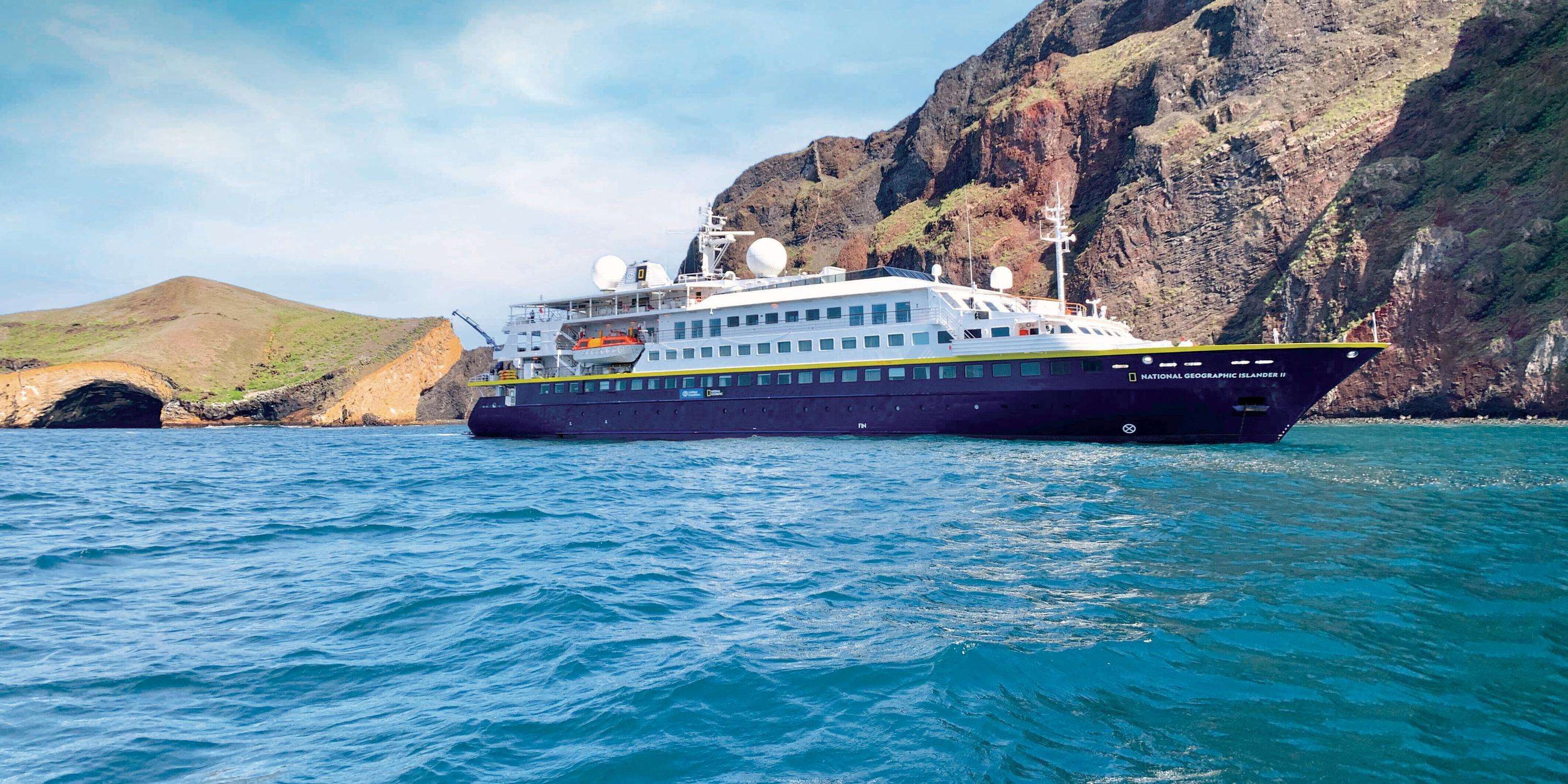


Route Guayaquil, Ecuador - Galapagosinseln - Galapagosinseln - Galapagosinseln - Galapagosinseln - Galapagosinseln - Galapagosinseln - Galapagosinseln - Guayaquil, Ecuador - Lima Mehr

Reiseinformationen
Datum
Hafen
Info
Ankunft
Abfahrt
23.04.27
Guayaquil, Ecuador
–
–
Guayaquil is a port city in Ecuador, known as a gateway to Pacific beaches and the Galapagos Islands. Stretching along the Guayas River is the waterfront Simón Bolívar promenade, home to La Rotonda monument. In the north, Las Peñas is a neighborhood full of colorful houses. Stairs lined with cafes and art galleries lead up Santa Ana Hill, site of Santa Ana chapel, a lighthouse and views of the city.
24.04.27
Galapagosinseln
–
–
The Galápagos Islands is a volcanic archipelago in the Pacific Ocean. It’s considered one of the world’s foremost destinations for wildlife-viewing. A province of Ecuador, it lies about 1,000km off its coast. Its isolated terrain shelters a diversity of plant and animal species, many found nowhere else. Charles Darwin visited in 1835, and his observation of Galápagos‘ species later inspired his theory of evolution
25.04.27
Galapagosinseln
–
–
The Galápagos Islands is a volcanic archipelago in the Pacific Ocean. It’s considered one of the world’s foremost destinations for wildlife-viewing. A province of Ecuador, it lies about 1,000km off its coast. Its isolated terrain shelters a diversity of plant and animal species, many found nowhere else. Charles Darwin visited in 1835, and his observation of Galápagos‘ species later inspired his theory of evolution
26.04.27
Galapagosinseln
–
–
The Galápagos Islands is a volcanic archipelago in the Pacific Ocean. It’s considered one of the world’s foremost destinations for wildlife-viewing. A province of Ecuador, it lies about 1,000km off its coast. Its isolated terrain shelters a diversity of plant and animal species, many found nowhere else. Charles Darwin visited in 1835, and his observation of Galápagos‘ species later inspired his theory of evolution
27.04.27
Galapagosinseln
–
–
The Galápagos Islands is a volcanic archipelago in the Pacific Ocean. It’s considered one of the world’s foremost destinations for wildlife-viewing. A province of Ecuador, it lies about 1,000km off its coast. Its isolated terrain shelters a diversity of plant and animal species, many found nowhere else. Charles Darwin visited in 1835, and his observation of Galápagos‘ species later inspired his theory of evolution
28.04.27
Galapagosinseln
–
–
The Galápagos Islands is a volcanic archipelago in the Pacific Ocean. It’s considered one of the world’s foremost destinations for wildlife-viewing. A province of Ecuador, it lies about 1,000km off its coast. Its isolated terrain shelters a diversity of plant and animal species, many found nowhere else. Charles Darwin visited in 1835, and his observation of Galápagos‘ species later inspired his theory of evolution
29.04.27
Galapagosinseln
–
–
The Galápagos Islands is a volcanic archipelago in the Pacific Ocean. It’s considered one of the world’s foremost destinations for wildlife-viewing. A province of Ecuador, it lies about 1,000km off its coast. Its isolated terrain shelters a diversity of plant and animal species, many found nowhere else. Charles Darwin visited in 1835, and his observation of Galápagos‘ species later inspired his theory of evolution
30.04.27
Galapagosinseln
–
–
The Galápagos Islands is a volcanic archipelago in the Pacific Ocean. It’s considered one of the world’s foremost destinations for wildlife-viewing. A province of Ecuador, it lies about 1,000km off its coast. Its isolated terrain shelters a diversity of plant and animal species, many found nowhere else. Charles Darwin visited in 1835, and his observation of Galápagos‘ species later inspired his theory of evolution
01.05.27
Guayaquil, Ecuador
–
–
Guayaquil is a port city in Ecuador, known as a gateway to Pacific beaches and the Galapagos Islands. Stretching along the Guayas River is the waterfront Simón Bolívar promenade, home to La Rotonda monument. In the north, Las Peñas is a neighborhood full of colorful houses. Stairs lined with cafes and art galleries lead up Santa Ana Hill, site of Santa Ana chapel, a lighthouse and views of the city.
02.05.27
Lima
–
–
Lima, the capital of Peru, lies on the country’s arid Pacific coast. Though its colonial center is preserved, it’s a bustling metropolis and one of South America’s largest cities. It’s home to the Museo Larco collection of pre-Columbian art and the Museo de la Nación, tracing the history of Peru’s ancient civilizations. The Plaza de Armas and the 16th-century cathedral are the heart of old Lima Centro.
03.05.27
Lima
–
–
Lima, the capital of Peru, lies on the country’s arid Pacific coast. Though its colonial center is preserved, it’s a bustling metropolis and one of South America’s largest cities. It’s home to the Museo Larco collection of pre-Columbian art and the Museo de la Nación, tracing the history of Peru’s ancient civilizations. The Plaza de Armas and the 16th-century cathedral are the heart of old Lima Centro.
04.05.27
Das heilige Tal der Inkas
–
–
The Sacred Valley is a region in Peru’s Andean highlands. Along with the nearby town of Cusco and the ancient city of Machu Picchu, it formed the heart of the Inca Empire. Stretching roughly 60 kilometers, it’s an area of fertile farmland and Spanish colonial villages like Pisac and Ollantaytambo. Pisac is known for its Sunday handicraft market and hilltop Incan citadel.
05.05.27
Das heilige Tal der Inkas
–
–
The Sacred Valley is a region in Peru’s Andean highlands. Along with the nearby town of Cusco and the ancient city of Machu Picchu, it formed the heart of the Inca Empire. Stretching roughly 60 kilometers, it’s an area of fertile farmland and Spanish colonial villages like Pisac and Ollantaytambo. Pisac is known for its Sunday handicraft market and hilltop Incan citadel.
06.05.27
Machu Picchu
–
–
Machu Picchu is an Incan citadel set high in the Andes Mountains in Peru, above the Urubamba River valley. Built in the 15th century and later abandoned, it’s renowned for its sophisticated dry-stone walls that fuse huge blocks without the use of mortar, intriguing buildings that play on astronomical alignments and panoramic views. Its exact former use remains a mystery.
07.05.27
Cusco
–
–
Cusco, a city in the Peruvian Andes, was once capital of the Inca Empire, and is now known for its archaeological remains and Spanish colonial architecture. Plaza de Armas is the central square in the old city, with arcades, carved wooden balconies and Incan wall ruins. The baroque Santo Domingo Convent was built on top of the Incan Temple of the Sun (Qoricancha), and has archaeological remains of Inca stonework
08.05.27
Cusco
–
–
Cusco, a city in the Peruvian Andes, was once capital of the Inca Empire, and is now known for its archaeological remains and Spanish colonial architecture. Plaza de Armas is the central square in the old city, with arcades, carved wooden balconies and Incan wall ruins. The baroque Santo Domingo Convent was built on top of the Incan Temple of the Sun (Qoricancha), and has archaeological remains of Inca stonework